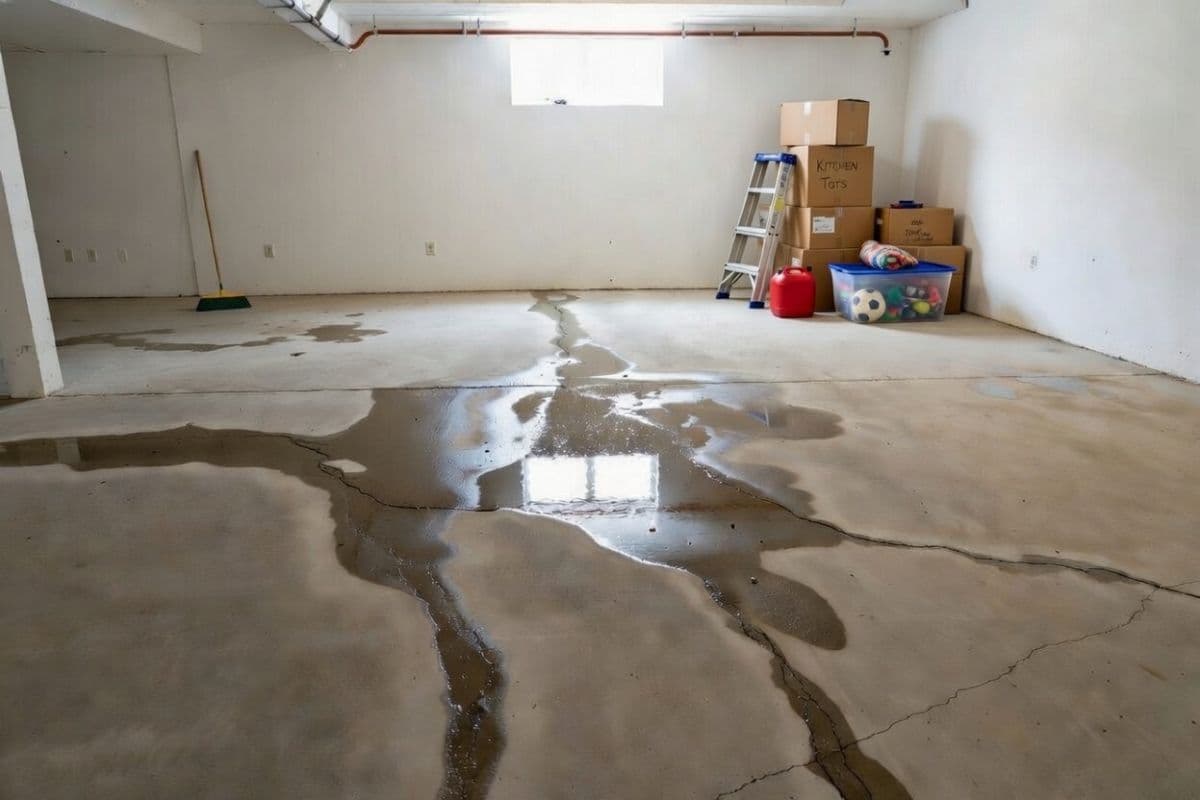
Is water coming up through the basement floor dangerous?
The water itself is not usually dangerous if it is groundwater — but the consequences of leaving it unaddressed are. Mold begins colonizing wet surfaces within 24 to 48 hours and can spread behind walls and under flooring invisibly before you notice it. Chronic floor moisture also accelerates rebar corrosion inside the slab, weakening the concrete over time. In severe cases, extreme hydrostatic pressure causes floor heaving — slab sections pushed upward — which is a structural issue requiring professional evaluation. Sewage backup through a floor drain is an immediate health hazard requiring professional remediation due to pathogen and bacteria contamination.
Can I just seal my basement floor to stop the water?
Surface sealing addresses the symptom, not the cause. Waterproof coatings reduce vapor transmission through porous concrete and can slow minor dampness, but they will not hold against active hydrostatic pressure. Water under pressure will either push the coating off the surface or find the next weakest point — a crack, a joint, or a penetration — and enter there instead. Crystalline waterproofing penetrates the concrete matrix and performs better than paint sealers, but even crystalline treatment is not effective against significant hydrostatic pressure without a drainage system relieving the pressure from below. Effective treatment means managing water movement under and around the slab, not blocking it at the surface.
Why does my basement floor only get wet in one spot?
A single wet spot that appears regardless of weather is most likely a plumbing leak under the slab — a supply line, drain pipe, or sewer line running beneath the concrete. Confirm this with the main water shutoff test: turn off your home’s main water supply for several hours and see if the wet spot stops appearing. A warm spot on an otherwise cold floor, the sound of running water with no fixtures active, or an unexplained increase in your water bill all support a plumbing diagnosis. If the wet spot appears only during or after rain and is located along the floor-wall perimeter, it is likely cove joint seepage driven by hydrostatic pressure rather than a plumbing issue.
Will a dehumidifier fix water coming through the floor?
No. A dehumidifier removes water vapor from the air but cannot stop liquid water from entering through the slab under pressure. Running a dehumidifier in a basement with active floor water intrusion will reduce ambient humidity and help prevent mold from spreading to dry areas, but it is a damage-control tool, not a solution. A dehumidifier pulling moisture from the air while the floor is actively wet is simply removing water that entered through the floor — you are managing consequences rather than fixing the source. Address the water entry first with drainage improvements, crack repair, or a sump pump, then use a dehumidifier to maintain target humidity in the dry space.
How much does it cost to fix water coming up through the basement floor?
Cost depends entirely on the cause and severity. Gutter cleaning and downspout extensions — the highest-impact low-cost fix for surface water issues — run $20 to $300 DIY or $150 to $500 professionally. Soil regrading costs $500 to $3,000. Floor crack injection runs $250 to $500 per crack professionally. A new sump pump installation costs $800 to $3,000. A full interior perimeter drainage system — the correct solution for persistent hydrostatic pressure — runs $3,000 to $10,000 depending on basement size. Exterior waterproofing and excavation can reach $8,000 to $25,000 for severe cases. Sub-slab plumbing repair ranges from $500 to $4,000 depending on pipe location and access. Always start with the least invasive and least expensive diagnostic steps before committing to major work.
Should I waterproof my basement floor before finishing it?
Absolutely, and skipping this step is one of the most expensive mistakes in basement finishing. Any moisture entering through the slab gets trapped behind finished walls, under flooring, and inside insulation once the space is enclosed — creating conditions for mold growth that may not be discovered until significant damage has occurred. At minimum, perform the plastic sheet test described in this guide to confirm whether vapor migration through the slab is occurring before framing any walls. If the test shows moisture, address it before finishing. A waterproofing investment before finishing is dramatically cheaper than mold remediation and reconstruction after the fact.
What is the cove joint and why does it leak?
The cove joint is the gap that runs along the entire perimeter of the basement where the floor slab meets the foundation wall. The floor and wall were poured at different times during construction and never truly bonded — there is always a small gap at this joint. When hydrostatic pressure builds below and around the foundation, water travels along the path of least resistance and the cove joint perimeter is almost always that path. Caulk, hydraulic cement, and epoxy applied to the cove joint from inside will hold temporarily but will not permanently stop water under pressure — the pressure will push the sealant out or route around it. The correct solution is an interior drainage channel installed along the perimeter that intercepts water at the cove joint and routes it to a sump pit rather than trying to block it.