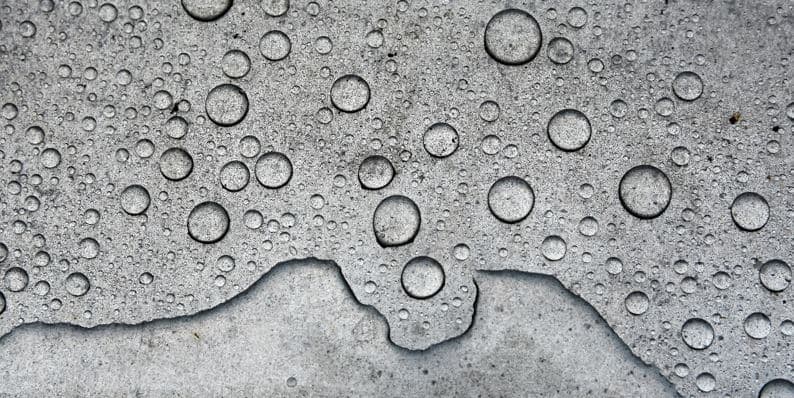
Crystalline waterproofing is a chemical treatment for concrete and masonry that penetrates the concrete matrix and grows insoluble crystalline structures inside the capillary pores and micro-cracks, permanently blocking water migration through the material rather than simply coating the surface. Unlike barrier-based waterproofing methods such as membrane sheets, tar coatings, or paint sealers that sit on top of the concrete and eventually crack, peel, or degrade, crystalline treatment becomes part of the concrete itself and cannot be separated from it. The crystals remain chemically dormant when dry and reactivate in the presence of moisture, allowing the material to self-seal new hairline cracks up to approximately 0.5 millimeters wide without any additional application. Crystalline waterproofing is used as an admixture in new concrete pours, as a topical slurry on existing foundation walls, and as a dry-shake treatment on fresh floor slabs, making it applicable to both new construction and existing basement retrofits.
For as long as humans have built with concrete, they have fought a losing battle against water. Concrete is naturally porous, filled with millions of microscopic capillary tunnels that act like a hard sponge. Over time, water seeps through these pores, leading to gradual rebar corrosion, efflorescence, and the chronic dampness that plagues so many basements. Traditional barrier methods — plastic sheets, tar coatings, paint sealers — sit on the surface and eventually fail. Crystalline waterproofing solves the problem from the inside out.
The Science: How Crystalline Waterproofing Works
Crystalline waterproofing consists of proprietary active chemicals — typically a blend of portland cement, silica sand, and reactive chemical compounds — delivered either as an admixture mixed into fresh concrete or a topical slurry brushed onto an existing wall. When these chemicals contact moisture and un-hydrated cement particles inside the concrete matrix, they trigger a chemical reaction that grows long, needle-like insoluble crystals that fill and seal the capillary pores and micro-cracks from within.
The crystals are not a coating. They grow through the full depth of the concrete, bonding permanently to the material. When the concrete is dry, the crystals lie dormant. When water contacts the treated concrete again — through a new hairline crack or previously unsealed pore — the crystallization process reactivates and new crystals form to seal the opening. This self-healing behavior is the defining characteristic that separates crystalline technology from every other waterproofing method.
Limitations to Understand
Crystalline waterproofing is not a complete waterproofing system on its own in most basement situations. Key limitations:
Crack size limit
Self-healing is effective on hairline cracks up to approximately 0.5mm. Larger cracks, displaced cracks, or structural cracks require mechanical repair (epoxy or polyurethane injection) before or alongside crystalline treatment. See our foundation crack repair cost guide.
Not a drainage substitute
Crystalline treatment reduces water migration through the concrete wall itself but does not address hydrostatic pressure from groundwater accumulation. Homes with high water tables or chronic water intrusion still need a perimeter drainage system and sump pump in addition to crystalline treatment.
Surface preparation required
Topical applications require a clean, open-pore concrete surface. Painted walls, sealed surfaces, or walls with existing coatings must be mechanically prepared before treatment.
Block foundations
Crystalline treatment is less effective on hollow concrete block walls because water can travel through the hollow cores rather than through the block material itself. Block walls typically require interior drainage solutions.
The Three Application Methods
Integral Admixture
The admixture method adds crystalline chemicals directly to the concrete mix at the batch plant or in the truck before pouring. The entire foundation wall or slab becomes waterproof from core to surface. This is the gold standard for new construction — every cubic inch of concrete is treated uniformly with no surface prep required and no possibility of delamination. Admixture treatment adds approximately $0.50 to $1.50 per square foot to new foundation costs and is specified by structural engineers on commercial and high-end residential projects as a standard waterproofing measure.
Topical Slurry
The topical method applies a thick slurry of crystalline compound to an existing concrete wall using a brush, roller, or spray. It penetrates several inches into the concrete matrix and forms crystals throughout the treated depth. This is the standard retrofit method for existing basements and the most common application for homeowners upgrading a basement's moisture resistance before finishing. Topical application costs $3 to $8 per square foot installed by a professional, or $1 to $3 per square foot in materials for DIY application on properly prepared surfaces.
Dry Shake
Dry shake application spreads crystalline powder onto a freshly poured concrete slab before final finishing. The powder is worked into the top layer of concrete as it is finished, creating a dense, waterproof surface layer. Used primarily for garage floors, basement floor slabs, and commercial concrete flatwork where surface durability and moisture resistance are both priorities.
Crystalline vs. Traditional Waterproofing Methods
| Feature | Paint Sealers | Sheet Membranes | Crystalline Treatment |
|---|---|---|---|
| Location | Surface coating | Surface barrier | Internal matrix |
| Durability | 3 to 5 years | 10 to 20 years | Permanent |
| Self-healing | No | No | Yes (up to 0.5mm) |
| Works on wet surfaces | Some | No | Yes |
| Crack bridging | No | Limited | Limited (hairline only) |
| Block foundation | Poor | Good | Poor |
| DIY friendly | Yes | Difficult | Topical: yes |
| Typical cost (installed) | $1 to $3 per sq ft | $5 to $15 per sq ft | $3 to $8 per sq ft |
| Best use case | Minor dampness, paint refresh | New exterior construction | New pours, retrofit porous walls |
How Much Does Crystalline Waterproofing Cost?
| Application Method | DIY Cost | Professional Cost |
|---|---|---|
| Admixture (new pour) | N/A — batch plant addition | $0.50 to $1.50 per sq ft added to pour cost |
| Topical slurry (existing walls) | $1 to $3 per sq ft (materials) | $3 to $8 per sq ft installed |
| Dry shake (floor slab) | N/A — applied during pour | $0.50 to $1.50 per sq ft added to slab cost |
For a typical 1,000 square foot basement with 8-foot walls (approximately 400 linear feet of wall perimeter), a professional topical application runs $4,000 to $8,000 depending on surface preparation required and local labor rates. This is competitive with interior paint sealers at the high end but offers significantly better longevity and the self-healing benefit that no coating can match.
Crystalline treatment is often combined with a complete waterproofing system including interior drainage and a sump pump for comprehensive protection. In that context, the crystalline treatment handles wall seepage while the drainage system manages any water that does make it through or enters from other sources.
Is Crystalline Waterproofing Right for Your Basement?
Crystalline treatment is the right choice when:
You are pouring a new foundation and want the most durable long-term waterproofing built into the concrete itself
Your existing poured concrete basement wall is damp or seeping through the wall material (not through cracks or joints)
You are preparing a basement for finishing and want to address wall porosity before insulating and drywalling
You want a treatment that will not delaminate, peel, or require reapplication
You are retrofitting an old basement as part of a pre-finish audit
Crystalline treatment is not the right primary solution when:
Water is entering through large cracks, displaced joints, or the cove joint at the floor-wall intersection
You have a block foundation with hollow cores
Your basement floods from groundwater — drainage is the solution, not wall treatment
You are looking for a quick cosmetic fix — surface prep is required for topical applications to work correctly
Frequently Asked Questions
How long does crystalline waterproofing last?
Properly applied crystalline waterproofing is considered permanent. Because the crystals form inside the concrete matrix rather than on the surface, they cannot peel, crack, delaminate, or wear off. The active chemicals remain in the concrete indefinitely and reactivate whenever moisture is present to trigger new crystal growth. This is the fundamental advantage over coating-based methods that require reapplication every 3 to 10 years. The concrete itself may eventually crack or deteriorate, but the crystalline treatment within the intact material does not degrade.
Can crystalline waterproofing be applied to an existing basement?
Yes, through topical slurry application. The slurry is brushed or sprayed onto clean, prepared concrete surfaces and penetrates several inches into the wall. For topical application to work correctly, the surface must be free of paint, sealers, efflorescence, and contamination — mechanical preparation is often needed before treatment. The wall should be damp but not actively streaming water during application. Most manufacturers recommend keeping the treated surface moist for several days after application to support the crystallization reaction.
Is crystalline waterproofing better than Drylok or other paint sealers?
For long-term effectiveness on porous poured concrete walls, yes. Paint sealers including Drylok sit on the concrete surface and physically block pores with a coating that eventually degrades, cracks under hydrostatic pressure, or peels if applied over a damp surface. Crystalline treatment penetrates the concrete and grows crystals that are bonded to the material permanently and cannot be pushed off by hydrostatic pressure the way a surface coating can. For minor dampness on a wall that will not be finished, a quality paint sealer is a reasonable budget option. For a basement being finished or a wall with consistent seepage, crystalline treatment is the more durable choice. See our Drylok vs RadonSeal comparison for a full paint sealer breakdown.
Does crystalline waterproofing work on block foundations?
Not as effectively as on poured concrete. Block foundations have hollow cores that allow water to travel through the block cavities regardless of how well the block material itself is treated. Crystalline treatment seals the block material and mortar joints but cannot fill the hollow cores, which means water that enters through the top of the wall or through failed mortar joints can bypass the treatment entirely. Block basement walls typically require interior drainage solutions — a perimeter French drain that captures water at the base of the wall and channels it to a sump pump — rather than wall treatment as the primary waterproofing approach.
What brands of crystalline waterproofing are most commonly used?
Xypex and Kryton (KIM — Kryton Integral Method) are the two dominant commercial crystalline waterproofing brands used by contractors on residential and commercial projects. Sika and BASF also produce crystalline admixture products used in commercial construction. For DIY topical applications, RadonSeal Deep-Penetrating Concrete Sealer uses a similar silicate-based chemistry and is widely available at home improvement stores, though it is not a true crystalline product — it seals pores through a different chemical mechanism. True crystalline topical products for retrofit applications are available through waterproofing contractors and specialty building supply distributors.
How does crystalline waterproofing handle new cracks that form after application?
This is the self-healing feature. When a new hairline crack forms in treated concrete and water contacts the crack, the dormant chemicals in the surrounding concrete reactivate and grow new crystals that fill the crack from the inside. This self-healing mechanism is effective on cracks up to approximately 0.5 millimeters wide under most manufacturers' specifications. Larger cracks, particularly any crack showing displacement where one side has shifted relative to the other, exceed the self-healing capacity and require mechanical repair with epoxy or polyurethane injection. Structural cracks should always be evaluated by a professional before relying on self-healing to address them.
Can I apply crystalline waterproofing myself?
Topical slurry products are available for DIY application and can be effective when surface preparation is done correctly. The wall must be clean, free of paint and sealers, and mechanically opened — typically by wire brushing or pressure washing — so the product can penetrate rather than sitting on a sealed surface. The wall should be pre-wetted before application and kept damp for several days afterward to support crystal growth. DIY material costs run $1 to $3 per square foot. Professional application at $3 to $8 per square foot includes surface preparation, which is the step most DIY applications get wrong. If the surface is not properly prepared, the product will not penetrate and will perform no better than a paint sealer.
Glossary of Crystalline Waterproofing Terms
Crystalline Waterproofing
A concrete treatment technology that uses reactive chemical compounds to grow insoluble crystals inside the concrete matrix, permanently sealing capillary pores and hairline cracks. Distinguished from coating-based methods by penetrating the concrete rather than sitting on the surface, and by the ability to self-heal new cracks in the presence of moisture.
Capillary Pores
Microscopic channels and voids in the concrete matrix created during the curing process as water evaporates and cement hydrates. These pores are the primary pathway for water migration through concrete walls. Crystalline treatment fills these pores with crystals to block water movement through the material.
Admixture
A chemical added to fresh concrete at the batch plant or mixing truck before pouring. Crystalline admixtures distribute the reactive chemicals throughout the entire concrete pour, making every cubic inch of the finished wall or slab waterproof rather than just the surface layer.
Topical Slurry
A thick paste of crystalline compound mixed with water and applied to the surface of existing concrete. Penetrates several inches into the concrete matrix and grows crystals throughout the treated depth. The standard retrofit method for existing basement walls.
Self-Healing
The ability of crystalline-treated concrete to reactivate dormant chemicals and grow new crystals when a new crack forms and moisture is present. Effective on hairline cracks up to approximately 0.5mm wide. Not a substitute for mechanical repair of larger or displaced cracks.
Hydrostatic Pressure
The force exerted by water-saturated soil against a foundation wall. Crystalline treatment reduces water migration through the wall material but does not relieve hydrostatic pressure, which requires a perimeter drainage system. High hydrostatic pressure can force water through even treated concrete at joints, cracks, and penetrations. See our French drain vs sump pump guide.
Integral vs Topical Application
The two primary crystalline application methods. Integral (admixture) treatment is added to fresh concrete and treats the entire pour uniformly — used in new construction. Topical treatment is applied to hardened concrete surfaces — used in retrofits. Integral treatment is generally considered more effective because the chemicals are distributed throughout the full depth of the concrete rather than penetrating from one surface.
Efflorescence
White, chalky mineral deposits on concrete surfaces caused by water carrying dissolved salts through the wall and depositing them as it evaporates on the surface. A visible indicator of water migration through the wall and often the first sign that crystalline or other waterproofing treatment is needed. Must be removed by mechanical cleaning before topical crystalline application. See our efflorescence guide.